Polling is a confession.
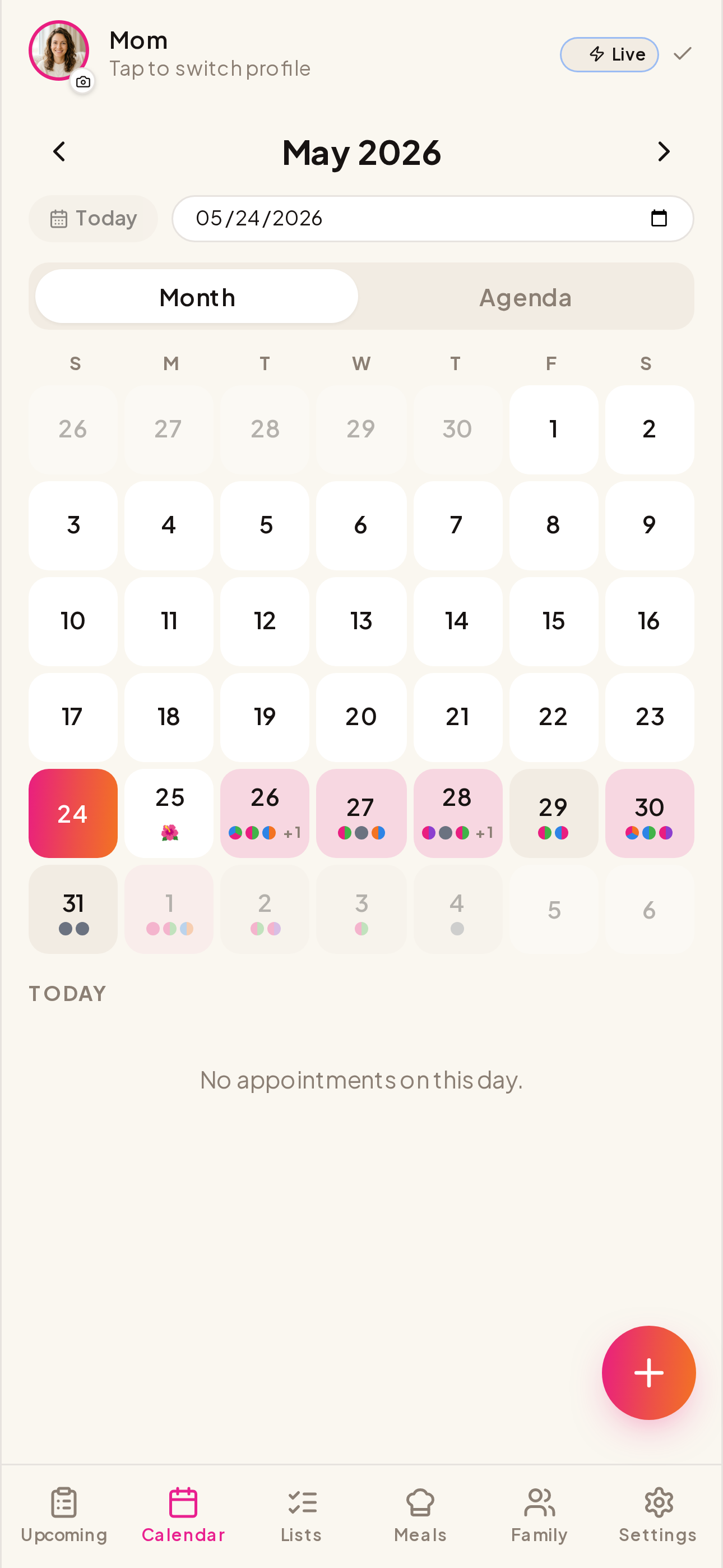
Most family calendars refetch the family data every few minutes. That's a polling architecture. It means stale views, wasted battery, and exactly the kind of "Wait, did you see I added that?" misalignment that destroys trust in the tool.
We measured Cozi at ~5-minute polling intervals. FamilyWall is similar. We replaced the whole thing with Server-Sent Events on day one.
SSE, with a polling safety net.
Every device opens an EventSource to GET /api/families/{code}/stream when it boots. The server pushes a tiny revision event the moment any mutation lands; the client refetches the family doc in the background. No polling, no battery drain, no stale state.
Idle sessions make zero polling GETs (vs the old design's 720/hour). Live-update latency dropped from "up to 5 seconds" to ~130ms in our measured tests. There's still a 30-second polling fallback for corporate networks that block SSE — defense in depth.
- Heartbeats every 25s keep the connection alive through reverse proxies
- Exponential reconnect (1.5s → 30s cap) for transient outages
- Singleton hub with per-family async queues — slow consumers drop oldest events, never block
- nginx X-Accel-Buffering: no so the ingress proxy doesn't sit on each event
The 6-char family code is not a credential.
Most family apps treat the join code as both an identifier AND a credential — knowing it grants access. That's the same security model as a hotel WiFi password. We rebuilt it.
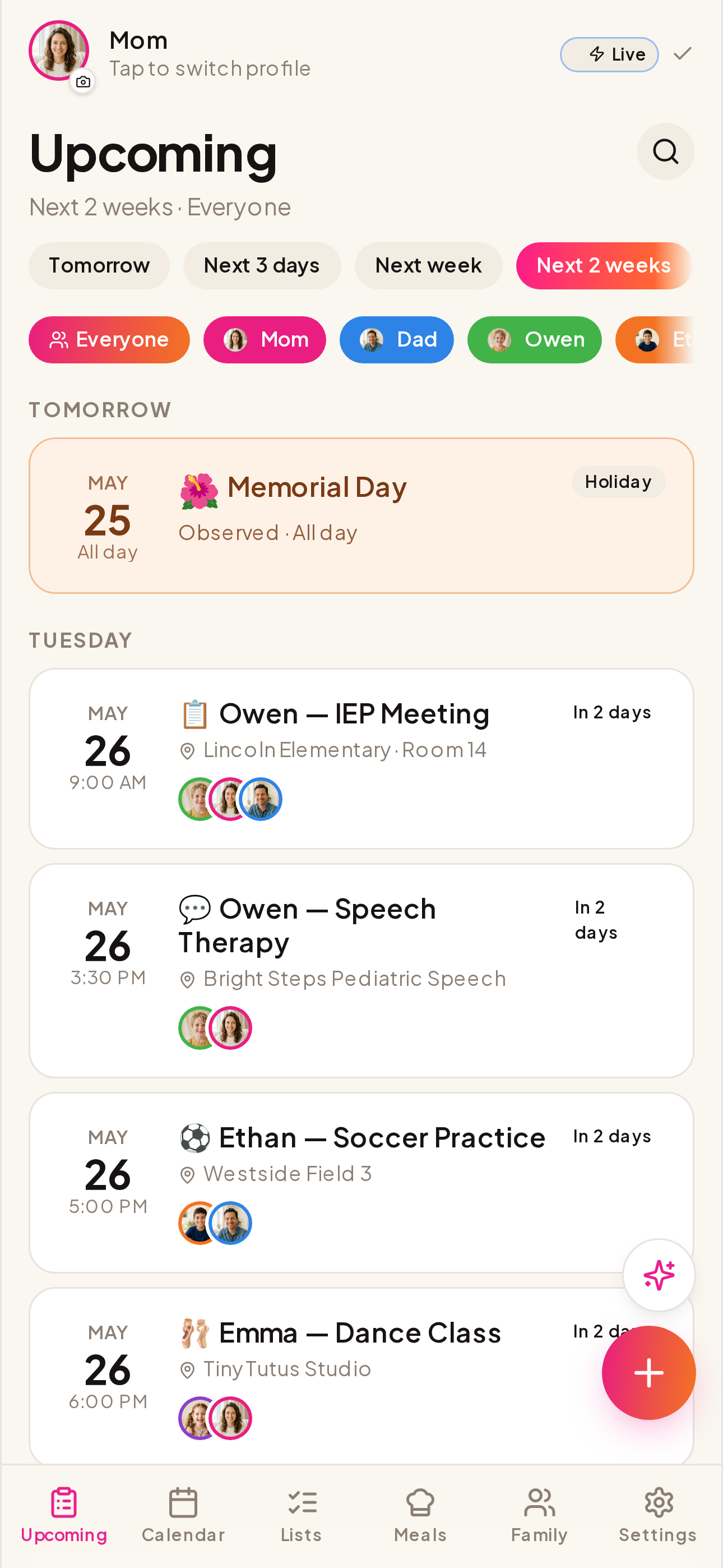
The 6-char family code (e.g., DEMO99) is now just an identifier. To join, you scan a 60-second pairing code generated by an existing device (Netflix-/Hulu-/Apple-TV style). The new device gets its own per-device bearer token. The token is stored as a peppered SHA-256 hash server-side — even a database breach doesn't leak tokens.
- 60-second pairing codes single-use, no replay
- Per-device revocation — lose your phone, kill just that device, the rest of the family stays signed in
- Encrypted OAuth refresh tokens at rest (Fernet) — Google Calendar tokens are never readable from the DB
- Privacy-safe audit log — every write is logged with hashed IPs/UAs (peppered SHA-256) so forensics are possible but a stolen audit-log dump is useless
- Redis-backed rate limiting across replicas so the limits are real, not per-pod theater
Measured, not marketed.
Related features
Trustworthy in real time. Or it's not a calendar.
Our Life is built on Server-Sent Events, per-device bearer tokens, encrypted OAuth, and a privacy-safe audit log. Most family calendars don't even have HTTPS to the family doc figured out.
Get the launch invite